
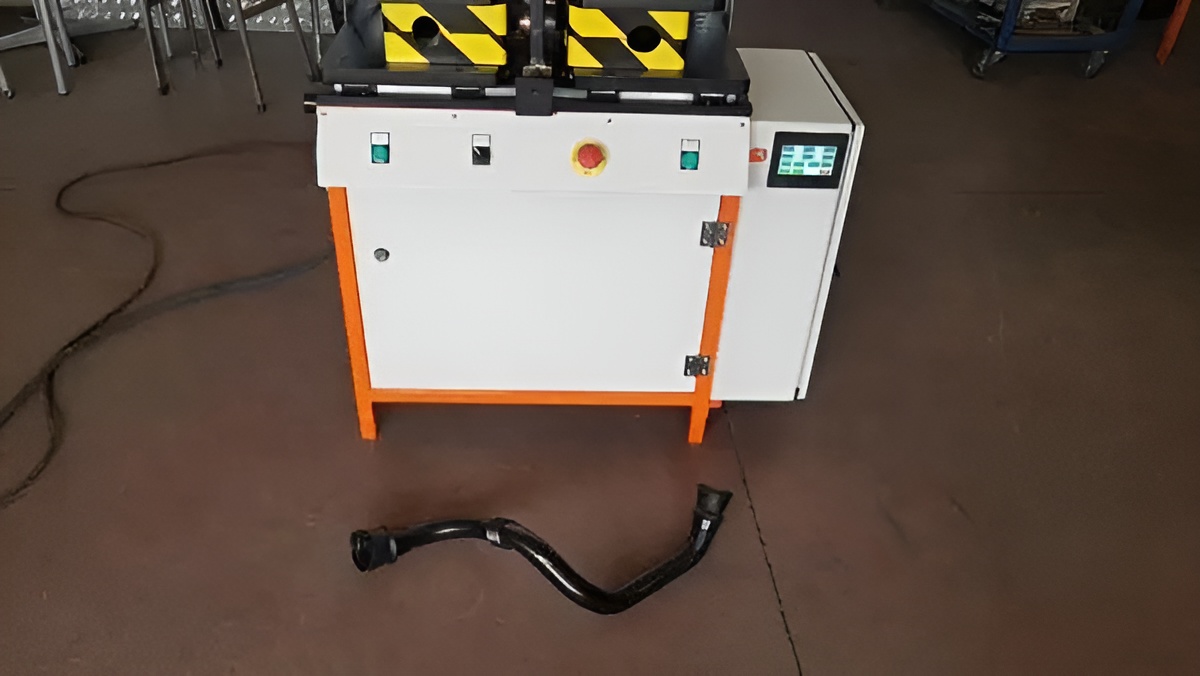
The quality of plastic pipes used in the automotive supply industry is assessed by more than dimensional accuracy alone. Leak-tight joints, connection strength, and consistent results throughout production are equally important. A weld that looks sound from the outside may fail under pressure if it was not formed under suitable conditions.
In a production line consisting of cutting, welding, and inspection stages, the welding station directly affects product performance. At this station, the geometry and temperature of the heating tool, the welding mold that melts the joining surfaces, must be managed together with processing time, applied force, and part positioning.
Mold and temperature control in automotive plastic processing machines is therefore a fundamental aspect of production quality. When planning integrated production lines for the automotive supply industry, every stage, from cutting to final inspection, must support the others. Consistent results at the welding station also depend on the dimensional accuracy and surface quality achieved in earlier stages.
İçindekiler Tablosu
How Does a Pipe Welding Machine Work?
A pipe welding machine heats the plastic surfaces to be joined in a controlled manner until they are ready for welding. The parts are then held together under a specified pressure, allowing the joint to cool and develop strength. In this application, the process sometimes referred to as “bonding” involves joining surfaces through heat.
The process consists of four main steps:
- Heating the tool: The tool is brought to a temperature suitable for the material and application.
- Moving the parts into position: The secured parts are moved into the heating position in a controlled manner.
- Melting the joining surfaces: The surfaces are heated to form the molten layer required for welding.
- Joining under pressure: The heated surfaces are brought together and held in position for a specified period.
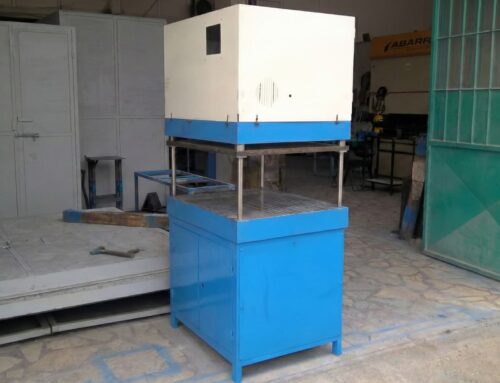
Meşe Makina’s Pipe Welding Machine operates by automatically moving the parts toward heating tools capable of reaching 450 °C, then holding the parts under pressure after their surfaces have melted. 450 °C is not the welding temperature to be used for every plastic; it is the machine’s stated heating capacity. The operating temperature is determined according to the material’s properties and the welding requirements of the part.
Why Is Heating Tool Temperature So Important?
The aim during welding is to create a sufficient and uniform molten layer on the surfaces to be joined. Temperatures outside the appropriate range affect the properties of this layer and the strength of the connection.
Low temperatures result in insufficient melting. When the temperature remains below the required range for the material, the surfaces do not reach a suitable condition for welding. Even if the parts appear to have bonded, the joint may not develop sufficient strength. This condition, commonly referred to as a “cold weld,” creates a risk of leakage or joint separation under pressure.
Excessively high temperatures degrade the material. Exceeding suitable temperature and time limits can cause material degradation in the weld area. Excessive melting, loss of shape, and excessive flash can also result from an imbalance between temperature, time, and pressure. Increasing the temperature alone does not produce a stronger weld.
Temperature distribution across the tool surface is just as important as the setpoint. Uneven heating creates different melting conditions across the joining surface. Seeing the target temperature on the control panel does not, by itself, confirm that the entire working surface is at the same temperature.
Each material and part has a suitable operating range. Process settings must be revalidated when the plastic type, wall thickness, or joint geometry changes. Using validated temperature, time, and pressure settings as stored recipes helps maintain production consistency.

Heat Alone Is Not Enough: Balancing Time and Pressure
The right temperature is only one part of a successful weld. Heating duration, how quickly the parts are brought together, and the pressure applied during joining also determine the result.
Melting Time
Melting time affects the amount of heat absorbed by the surface and the depth of the molten layer. Insufficient time can lead to incomplete melting, while excessive time can cause over-softening and dimensional distortion.
For this reason, weld quality must be verified through testing before reducing heating time to shorten the production cycle. Production speed and joint strength must be considered together.
Time Between Tool Withdrawal and Joining
The surfaces begin to cool as soon as heating ends. Any delay between withdrawing the heating tool and bringing the parts together changes the condition of the prepared surfaces.
This transition must take place within a time suitable for the material and remain consistent from one cycle to the next. Automation reduces variation in changeover time by controlling the movement sequence and timing.
Joining Force and Holding Time
Insufficient force prevents the surfaces from joining properly. Excessive force, however, can push molten material out of the joint and distort the weld geometry.
Holding time allows the joint to cool and develop strength under pressure. Releasing the part too early increases the risk of deformation at the connection. Temperature, time, and pressure settings must therefore be validated together.
Mold Design and Positioning Accuracy
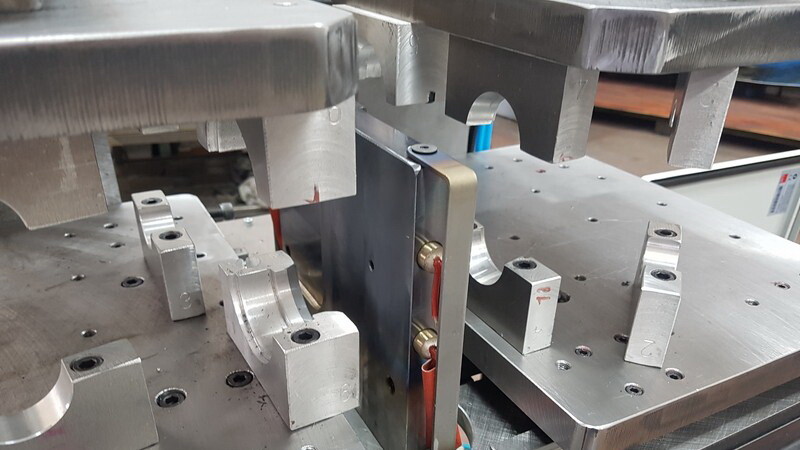
Even with accurate temperature control, incorrect positioning of the part relative to the heating tool can prevent uniform heating across the joint. The working surface of the heating tool must match the part’s weld geometry. The flatness of the joining surfaces and their position relative to the heater are essential to balanced heating.
Alignment of the pipe axes and secure positioning throughout the process also affect weld quality. The clamping arrangement must prevent movement without deforming the plastic body. Even a slight positioning error can create uneven contact and pressure around the joint.
As production continues, the tool surface must be checked for wear and material buildup. Adhering residue changes surface conditions and heat transfer. Cleaning methods must avoid damaging the tool surface or any coating it may have.
Regular temperature monitoring also supports maintenance planning. Recording unusual heating behavior and recurring temperature deviations at the welding station makes it easier to detect problems early.
Before Welding: Cutting Quality
Weld quality begins to take shape before the part reaches the welding station. Pipe ends that are cut at an angle, have burrs, or fall outside dimensional tolerances make it difficult to align the joining surfaces correctly. Temperature and pressure settings cannot compensate for every cutting defect.
For this reason, pipe length, cut surface evenness, and burr formation must be checked after cutting. Welding surfaces must also be cleaned of dirt and residue that could interfere with the process.
Meşe Makina’s 25-ton Rigid PVC Pipe Cutting Machine was developed for cutting rigid PVC pipes. When selecting cutting equipment, the material, part geometry, and required cut quality must be considered together. This ensures that preparation before welding aligns with the production line’s quality objectives.
The Cost of Uncontrolled Heat in Production
The cost of a temperature deviation at the welding station is not limited to the defective part alone. Late detection can result in sorting, reinspection, scrap, delivery delays, and production line downtime.
For example, a leak-tightness problem identified at the end of a shift may require earlier production to be inspected as well. If it is unclear which parts were produced under acceptable conditions, the batch requiring inspection becomes larger. A small process deviation can turn into a substantial workload for production and quality teams.
Defective parts reaching the customer can also lead to customer complaints and additional validation requirements. Linking process records to individual parts or batches makes it easier to determine the scope of a problem. Traceability helps separate conforming products from suspect products and limits the necessary intervention to the relevant batch.
How Can Effective Control Be Achieved?
A stable welding process requires settings to be maintained throughout production, as well as correctly established at the outset. The following elements must be considered together when designing the control system:
- Continuous temperature monitoring: The target and actual temperatures are compared. Measuring device accuracy and temperature distribution across the working surface are checked regularly.
- Material-specific recipes: Validated temperature, time, and pressure settings are stored for each product. Setting changes are authorized and recorded.
- Repeatable movements: Automatic approach and joining movements reduce operator-related variation in timing and positioning.
- Intervention when limits are exceeded: The system is designed to prevent a cycle from starting or to initiate a controlled stop when critical parameters fall outside defined limits. Affected parts are set aside for inspection.
This approach is based on the poka-yoke principle of preventing errors before they occur.
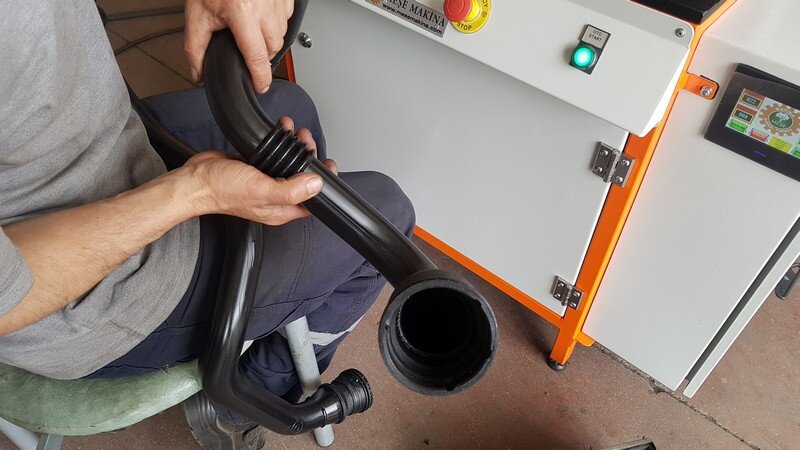
At the final stage, weld quality is verified through tests appropriate to the product. Products manufactured using Meşe Makina’s pipe welding machine have successfully passed internal pressure tests at 8 bar. This result applies to the products tested. Test conditions and acceptance criteria for other parts are determined according to their application requirements.
Controlled Welding for Consistent Production Quality
Reliable welding in automotive plastic processing machines begins with the right mold design and is completed through controlled heating, precise positioning, and appropriate pressure. Cutting quality, regular maintenance, and product testing are also integral parts of the process.
The goal is both to achieve a successful result on an individual part and to maintain the same quality throughout production. To accomplish this, temperature, time, and pressure must remain within validated limits during every cycle. Together with Meşe Makina, you can define the mold, welding, and automation requirements that match your part geometry and production goals.
For mold and automation solutions tailored to your parts, contact Meşe Makina.

Leave A Comment