
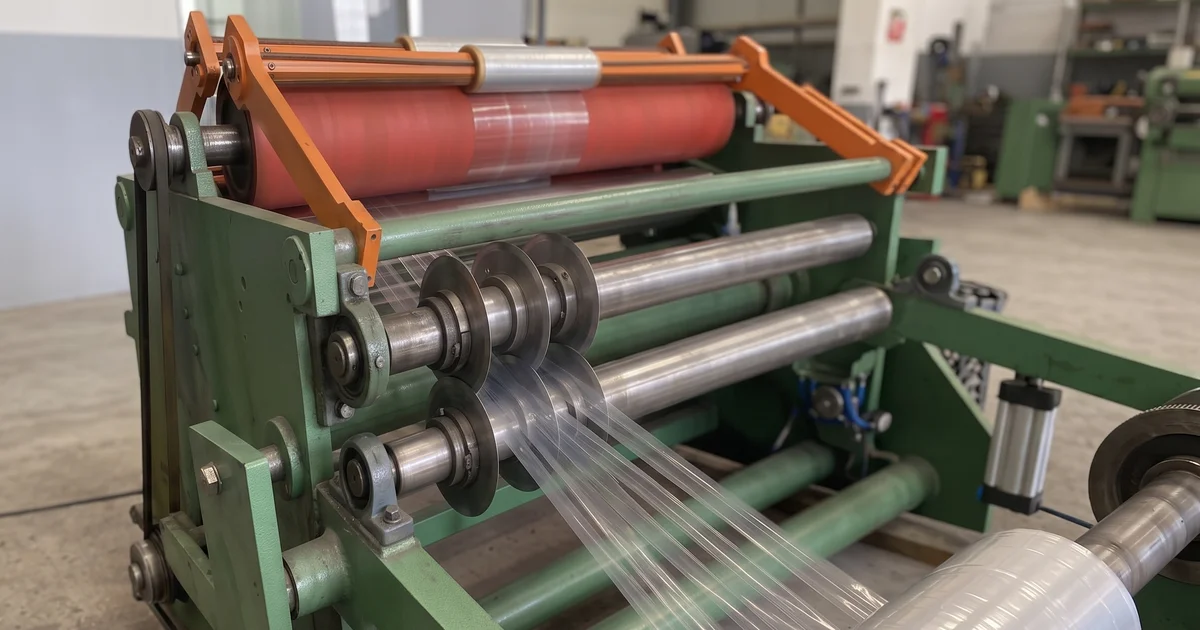
In the packaging, label, paper, foil, and film industries, slitting machines perform one of the most critical stages of production. Dividing a master roll into narrower rolls with the required widths, clean edges, and controlled winding depends on the correct management of many factors, from blade adjustment and positioning to tension control.
Even a small deviation in slit width or the cutting line can cause problems in subsequent printing and packaging processes, production downtime, or material loss.
At Meşe Makina, we design and manufacture slitting machines for the packaging industry. While developing our packaging slitting machine, which can process rolls up to 1600 mm wide, we place the factors that determine slitting accuracy and cutting quality at the center of the machine design.
In this article, we examine the key factors that affect slitting machine cutting accuracy, dimensional consistency, edge quality, and winding performance.
İçindekiler Tablosu
1. Cutting Method and Blade Type
Not every material is suitable for the same slitting method. When a cutting method that does not match the characteristics of the material is selected, achieving the desired cutting quality becomes difficult regardless of how advanced the slitting machine may be.
Razor slitting: Suitable for thin plastic films and lightweight materials. It is practical to set up and provides an economical solution. However, edge quality decreases when cutting thicker or harder materials.
Shear slitting: A method in which upper and lower circular blades operate according to the principle of scissors. It provides clean edges and high dimensional accuracy for paper, laminates, label materials, and many film applications.
Crush/score slitting: Based on separating the material by crushing it between a blade and a hard surface. It is used for certain applications involving nonwoven materials, textiles, and similar products. Depending on the material, deformation may occur along the cut edge.
Selecting the correct cutting method is the first step toward achieving consistent and high-quality slitting results. When configuring the machine, the material to be processed and the expected cutting quality should be evaluated together.
2. Blade Quality, Sharpness, and Wear
Blade material, hardness, geometry, and sharpening condition directly affect slitting performance and edge quality. Different blade materials, such as tool steel, HSS, and tungsten carbide, can be selected according to production requirements.
A dull or unsuitable blade can:
- Create burrs, dust, and fibers along the cut edge,
- Pull the material during slitting,
- Cause dimensional deviations,
- Create irregularities along the wound roll edges.
Regular inspection of the blades, together with sharpening or replacement when necessary, is essential for maintaining consistent cutting quality.
3. Blade Adjustment: Overlap, Angle, and Side Pressure
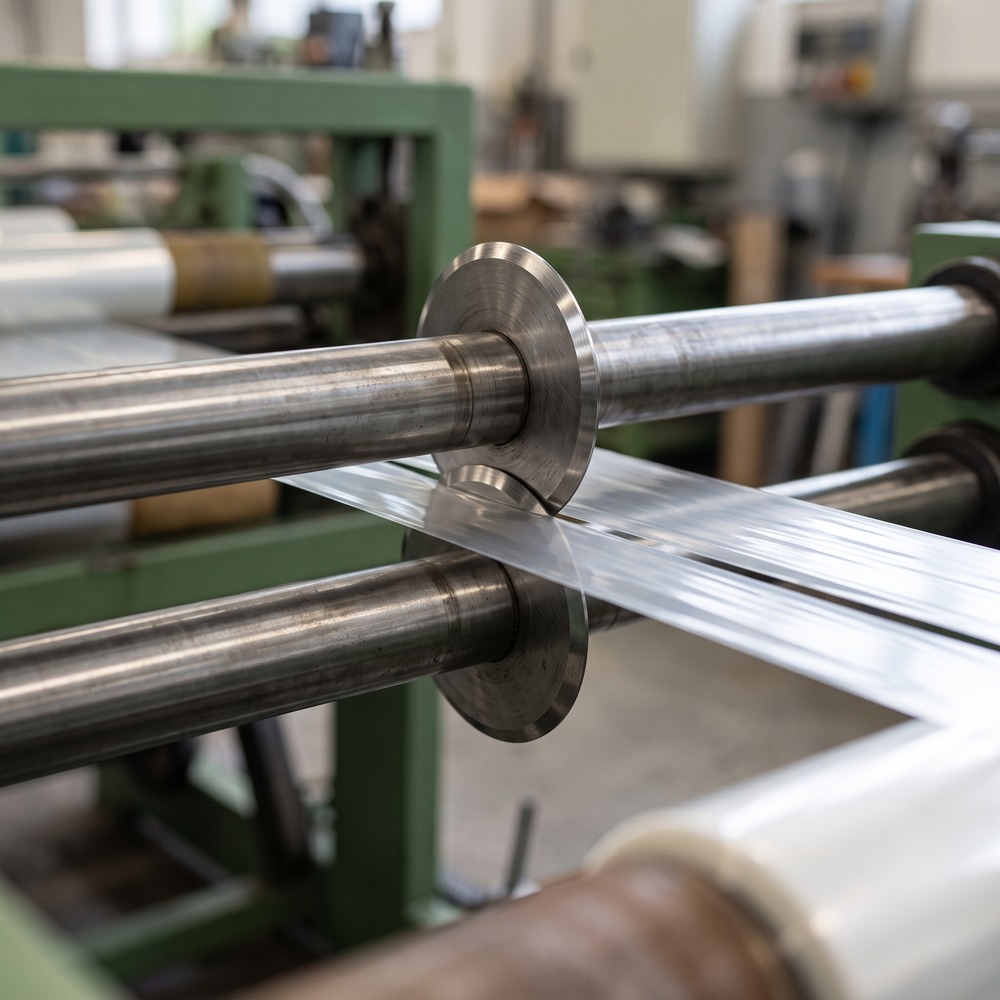
In shear slitting, the settings between the upper and lower blades directly affect cutting accuracy and edge quality. In particular, blade overlap, blade angle, and side pressure must be adjusted correctly.
When the overlap is excessive, the blades wear faster and the material is subjected to unnecessary stress.
When the overlap is insufficient, the material may not be completely cut and tearing can occur along the edge.
When the blade angle is incorrect, the upper blade does not make proper contact with the lower blade, causing burr formation and increased blade wear.
Incorrect side-pressure adjustment disrupts blade contact and prevents a clean and consistent cut from being achieved.
These settings are determined according to material thickness, hardness, the type of blade being used, and operating speed.
4. Blade Positioning System
Correct blade positioning according to the required slit widths is one of the main factors determining the final roll dimensions.
In manual positioning systems, the result largely depends on the operator’s measuring and adjustment skills. Particularly in production environments where products or dimensions are changed frequently, this can lead to lost time and variations in machine settings.
Automatic blade positioning systems use servo motors and precision measuring systems to position the blades quickly and repeatably. In operations with frequent size changes, they shorten setup times and reduce operator-related dimensional errors.
Blade positioning accuracy becomes especially important when cutting narrow strips. The Meşe Makina packaging slitting machine can achieve a minimum slit width of 11 mm.
5. Tension Control
Material tension in the unwinding, slitting, and rewinding sections directly affects both cutting accuracy and winding quality.
When tension is not properly controlled:
- The material fluctuates in the cutting area,
- Stretching and dimensional changes occur in flexible films,
- Wrinkling, loose rolls, or telescoping can occur during winding.
Closed-loop systems using feedback from load cells or dancer rollers continuously regulate braking or drive force in the unwinding and rewinding sections. This allows material tension to remain more stable throughout the slitting process.
The appropriate tension value must be determined for each material. Thin and flexible films cannot be processed using the same tension values as paper or more rigid materials.
Maintaining stable tension becomes even more important as roll diameter changes. The Meşe Makina slitting machine can handle unwind diameters of up to 1000 mm and rewind diameters of up to 650 mm. Across this diameter range, tension control is one of the fundamental design elements required for stable and uniform winding.
6. Edge Guiding System
The master roll is not always wound perfectly. When the material shifts to the right or left inside the machine, the cutting line can also move away from its intended position.
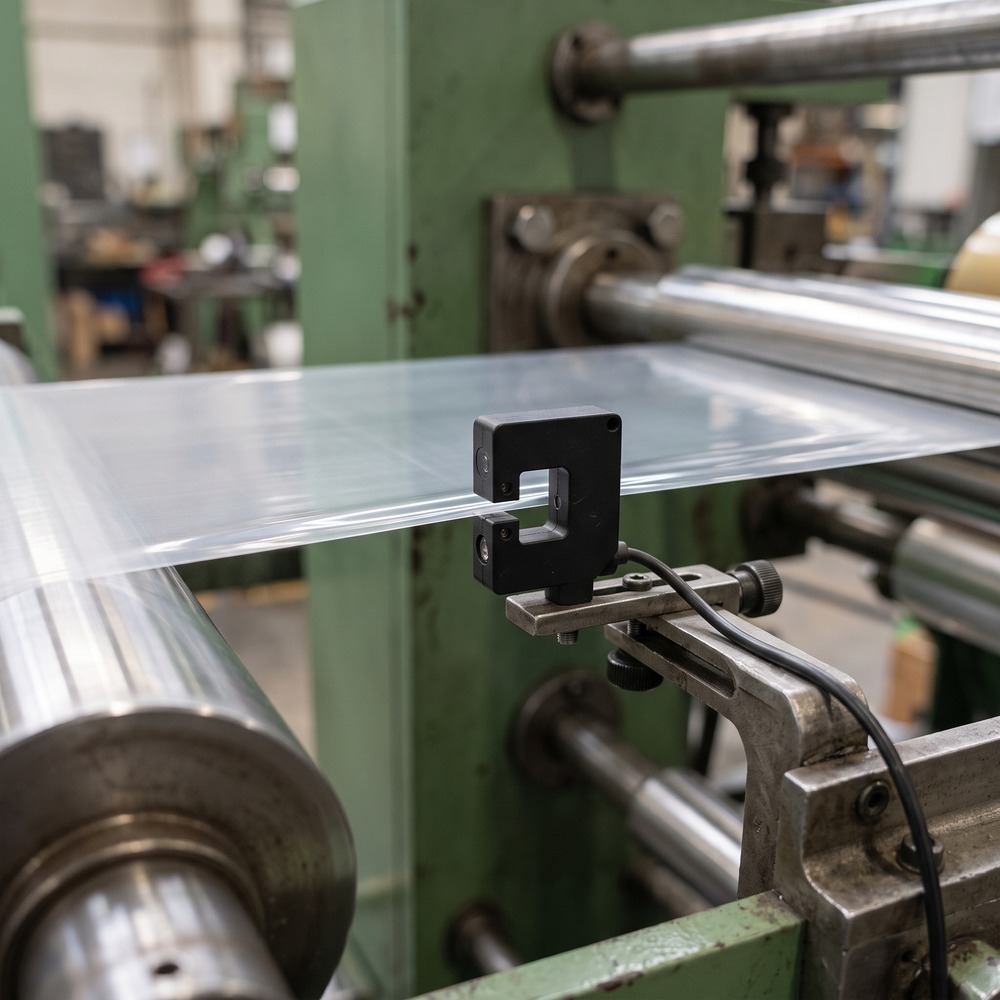
An edge guiding system (EPC) monitors the position of the material through sensors and makes the necessary corrections through the guiding mechanism. This ensures that the material enters the slitting section along the correct line.
Optical or ultrasonic sensors are used for edge guiding. For printed materials where cutting must follow a print reference, optical systems capable of detecting a printed line or registration mark can be used. For more complex control requirements, industrial vision systems can also be integrated into the production line.
A properly operating edge guiding system helps keep the cutting line stable, particularly with long rolls and at high operating speeds. The photoelectric edge control system used in the Meşe Makina slitting machine keeps the material correctly positioned throughout the cutting process.
7. Mechanical Structure: Rigidity, Vibration, and Runout
Stable operation of the blades and rollers during slitting depends on the mechanical structure of the machine.
A machine frame without sufficient rigidity can generate vibration, especially at high operating speeds. This vibration is transferred to the cutting line and reduces edge quality and dimensional consistency.
Similarly, runout in blade shafts, lower blade holders, or guide rollers prevents the blades from operating at exactly the same position during each rotation. This can result in wavy cut edges, variations in slit width, and inconsistent blade contact.
For this reason, the following elements are particularly important in slitting machine design and manufacturing:
- A rigid and precisely machined machine frame,
- Balanced rollers,
- Shafts manufactured within controlled tolerances,
- High-quality bearings and bearing components,
- Correct assembly.
Mechanical accuracy is important not only during the initial manufacturing stage but also for allowing the machine to maintain stable and repeatable performance over many years of operation.
8. Operating Speed
Increasing operating speed raises production capacity. However, as speed increases, mechanical and process-related effects on the slitting system also become more noticeable.
At high speeds:
- Vibration increases,
- Tension control becomes more difficult,
- Static electricity becomes more significant,
- Material guiding becomes more difficult,
- Blades and equipment may experience increased heat.
For this reason, slitting speed should not be determined solely according to the maximum speed the machine can reach. Material type, cutting method, roll characteristics, and the required cutting quality should all be evaluated together.
9. Material Characteristics
The physical properties of the material being slit determine how the machine should be configured.
The main characteristics that should be considered include:
- Material thickness and thickness variation,
- Flexibility and elongation behavior,
- Hardness and abrasiveness,
- Surface and coating properties,
- Straightness and winding quality of the master roll.
For flexible materials such as PE and stretch film, tension adjustment becomes more critical. Harder or more abrasive materials directly affect blade selection and blade wear rate.
Therefore, when different materials are processed on the same slitting machine, blade, tension, and speed settings must be adjusted accordingly.
10. Environmental Conditions and Static Electricity
Changes in temperature and humidity can affect the dimensional stability of paper and certain plastic materials.
Static electricity generated in plastic films can cause problems such as:
- Material sticking to rollers,
- Dust and foreign particles being attracted to the surface,
- Slit strips failing to separate properly after cutting.
Anti-static bars and a controlled production environment play an important role in reducing these problems and maintaining consistent slitting performance.
11. Maintenance and Operator Training
A slitting machine that does not receive regular maintenance gradually loses cutting accuracy and operating stability.
The following checks should be performed periodically:
- Inspection of the blades,
- Inspection of bearings and rollers,
- Inspection and calibration of tension sensors,
- Verification that the edge guiding system is operating correctly,
- Inspection of clearances in shafts and bearing systems.
Operator training is just as important as the machine equipment itself. Selecting the correct blade, tension, and speed settings for the material, following standardized procedures during job changes, and recognizing signs of wear at an early stage all help maintain production quality.
The operating and adjustment information provided during machine commissioning, together with subsequent technical support, contributes to maintaining correct machine use over time.
Frequently Asked Questions
What is the cutting tolerance of a slitting machine?
Cutting tolerance varies depending on the mechanical structure of the slitting machine, the blade positioning system, the material being processed, operating speed, and process settings. Therefore, there is no single tolerance value that applies to every application.
Precisely manufactured and correctly adjusted slitting systems can operate with tight tolerances and repeatable dimensions.
What causes dust and burrs along the cut edge?
The most common causes include dull blades, incorrect blade adjustment, a cutting method that is unsuitable for the material, and incorrect operating conditions.
The structure and coating properties of the material can also affect the amount of dust generated during slitting.
What causes telescoping in wound rolls?
Telescoping is generally caused by uneven winding tension, incorrect winding pressure or torque settings, variations in material thickness, and mechanical problems related to the winding shaft.
Proper alignment of the material as it reaches the winding point is also necessary for producing a uniform roll.
Conclusion
Cutting accuracy in a slitting machine does not depend on a single component or adjustment. Blade selection, blade adjustment, tension control, edge guiding, mechanical structure, operating speed, and material characteristics must all be considered together.
When these factors are managed correctly, rolls with clean edges, consistent dimensions, and uniform winding can be produced. Regular maintenance and correct operator adjustments also help maintain this level of cutting quality throughout production.
At Meşe Makina, we design and manufacture slitting solutions for different materials and production requirements. In addition to our standard models, our R&D department develops custom machines according to specific production needs.
You can explore our other machine solutions or contact us to learn more about slitting systems suitable for your project.

Leave A Comment